Today, Britta Winkelnkemper not only presents her game ideas, which largely revolve around Braille, but also tells us how she came up with this idea.
We at Braille 200 would like to thank Britta for her exciting insights and for sharing this idea with us all on here!
Educational game ideas for the visually impaired and blind
by: Britta Winkelnkemper – KINDER PONYS FÖRDERSPIELE
My name is Britta Winkelnkemper and I have been working as a holistic riding therapist for many years. I am also the author of the CHILDREN’S PONY DEVELOPMENT GAMES series. These are collections of developmental game ideas in card format that can be used in animal-assisted settings, but also in educational institutions, family contexts, and leisure areas to promote development in a fun and playful way.
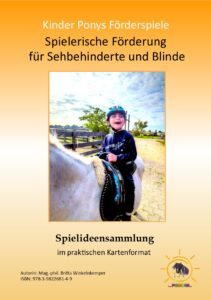
My new collection of game ideas for visually impaired and blind people is particularly close to my heart in memory of Tom. I owe its creation to Tom, a little boy who went blind due to an incurable disease. His mother came to me with Tom for equine therapy and was looking for activities and developmental opportunities for Tom, who was spending most of his time at home at the time. I accepted the challenge and have been researching animal-assisted therapy and developmental materials for blind children ever since. Unfortunately, it turned out that there are very few developmental materials and game ideas (especially for children) in this area. So I collected some game ideas, invented many more, and gathered a lot of game materials. It was important to me that the game materials were educational, fun, and could be easily made at home without much effort or expense.
Tom was a great help to me. He showed me that I needed to improve some of my game ideas. He showed me how mobility training with a pony works well, what blind children pay more attention to than sighted children, and his actions repeatedly gave me new ideas for games – even though Tom spoke very few words. This resulted in my collection of game ideas with a total of 58 cards in DIN A5 format. The individual cards feature pictures and descriptions of pony-assisted mobility training exercises, as well as a host of game ideas that can be played almost anywhere, with or without a pony.
I would like to thank Tom’s mom for allowing me to publish the pictures of Tom in my collection of game ideas, so that these game ideas, which gave Tom so much joy, can now help and bring joy to other children.
The Braille box
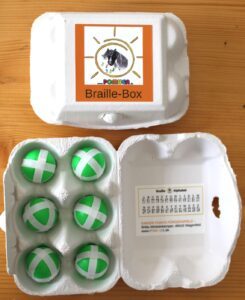
One game idea I would like to highlight from my collection is the Braille box, which can be seen in the photo. Some of you may be familiar with the idea of using table tennis balls, but these can easily slip out of blind children’s hands and be impossible to find. I use Velcro balls in my Braille Box, which even stick to some fabrics or can be quickly and easily stored on the pony strap or on separate objects in the immediate vicinity using Velcro adhesive dots or Velcro adhesive strips, for example, in order to lay the braille letter by letter. Sighted children also enjoy laying out their names – a good inclusion idea for educational institutions.
The magnetic snail
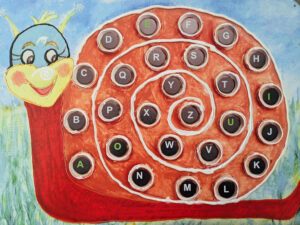
The ABC magnetic snail consists of a magnetic board (40 x 30 cm) with a picture of a snail and its shell. The snail carries the letters from A to Z in its shell. The fields in which the letters are located can be felt. The snail’s head, eyes, nose, mouth, and body can also be felt. The Braille letters from A to Z are attached to 26 round magnets. Tactile adhesive dots have been attached to the top of each magnet for orientation. A cube has been equipped with tactile adhesive dots. Magnetic game pieces are another addition.

Game idea 1: The Braille alphabet can be felt and named in order in the snail shell.
Game idea 2: The Braille alphabet has been mixed up and can be rearranged.
Game idea 3:
A word in Braille is hidden along the snail shell. Can you find it?
Game idea 4: Spell out your first name with the Braille magnets in the snail shell.
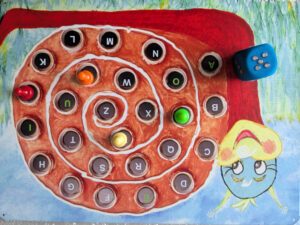
Game idea 5: Roll the dice, feel the number rolled, run your finger over the number of squares in the snail shell and say which letter you landed on. (Either count the ABC aloud or place the Braille magnets on the squares). Then say a word that starts with that letter (or a word from a higher category, e.g., a word related to Christmas, summer, school, etc.).
Game idea 6 (also for visually impaired and sighted players): Roll the dice and move the magnetic game piece along the number rolled according to the ABC squares. Say a word related to a previously agreed category that starts with the letter you are standing on. No word repetitions! If you can’t think of a word, you have to go back one square. The first person to reach Z wins. Alternatively, a previously agreed stake can increase the joy of winning (e.g., a cookie, a small surprise, etc.).
The game is therefore suitable for people of all ages and is even a good brain gym game idea for seniors. Thanks to the magnets, it can even be played in the car, on a boat, or on a pony without the pieces falling over or falling off.
The production of this prototype of my ABC magnetic snail is still very cost-intensive. I would be very happy to collaborate on the production of this educational board game. Britta Winkelnkemper www.POMUGA.de.
Schnecken, Bälle und ein kleiner Junge
Heute stellt euch Britta Winkelnkemper nicht nur ihre Spielideen vor, in denen es zu großen Teilen um Braille geht, sondern erzählt uns auch, wie es zu dieser Idee kam.
Wir bei Braille 200 bedanken uns herzlich bei Britta für die spannenden Einblicke und das Teilen dieser Idee.
Fördernde Spielideen für Sehbehinderte und Blinde
von: Britta Winkelnkemper – KINDER PONYS FÖRDERSPIELE
Ich bin Britta Winkelnkemper und arbeite seit vielen Jahren als ganzheitliche Reittherapeutin. Gleichzeitig bin ich Autorin der Reihe KINDER PONYS FÖRDERSPIELE. Das sind fördernde Spielideensammlungen im Kartenformat, die in tiergestützten Settings, aber auch in Bildungseinrichtungen, familiären Kontext und Freizeitbereichen eingesetzt werden können, um mit Freude und in Bewegung spielerisch zu fördern.
Meine neue Spielideensammlung für Sehbehinderte und Blinde liegt mir in Erinnerung an Tom besonders am Herzen. Die Entstehung verdanke ich Tom, einem kleinen Jungen, der durch eine unheilbare Krankheit erblindete. Seine Mama kam mit Tom zu mir in die Reittherapie und suchte nach Beschäftigungs- aber auch Fördermöglichkeiten für Tom, der zu dem Zeitpunkt seine Zeit überwiegend Zuhause verbrachte. Ich nahm die Herausforderung an und recherchierte seit dem Tag über die tiergestützte Förderung sowie über die Fördermaterialien für blinde Kinder. Leider stellte sich heraus, dass es in diesem Bereich nur sehr wenige Fördermaterialien und Spielideen (speziell auch für Kinder) gibt. So habe ich einige Spielideen gesammelt, viele Spielideen erfunden und dazu noch eine Menge Spielmaterialien zusammen getragen. Mir war es wichtig, dass auch Spielmaterialien dabei sind, die fördern, Spaß bereiten und zugleich auch innerhalb der Familien ohne großen Aufwand und für wenig Geld selber gestaltet werden können.
Tom war mir dabei eine große Hilfe. Er hat mir bei einigen Spielideen gezeigt, dass ich etwas nachbessern musste. Und er hat mir die Richtung gezeigt, wie Mobilitätstraining mit dem Pony gut funktioniert, auf was blinde Kinder intensiver achten, als Sehende und er hat mich durch sein Handeln immer wieder auf neue Ideen für Spiele gebracht – obwohl Tom nur wenige Worte sprach. Daraus entstand meine Spielideensammlung mit insgesamt 58 Karten im DIN-A-5-Format. Mit Bildern und Beschreibung werden auf den einzelnen Karten Übungen zum Ponygestützten Mobilitätstraining vorgestellt, aber auch eine Menge Spielideen, die sich mit und ohne Pony fast überall umsetzen lassen.
Ich danke Toms Mama für die Erlaubnis, die Bilder von Tom in meiner Spielideensammlung veröffentlichen zu dürfen, damit diese Spielideen, die Tom so viel Freude bereiteten, nun anderen Kindern helfen und Freude schenken.
Die Braille-Box
Eine Spielidee, die ich aus meiner Spielideensammlung herausgreifen möchte, ist die Braille-Box, die auf dem Foto zu sehen ist. Einige kennen die Idee vielleicht mit Tischtennisbällen, die aber blinden Kindern leicht und unauffindbar aus der Hand gleiten können. Ich nutze Klettbälle in meiner Braille-Box, die sogar an manchen Textilien kleben oder aber mittels Klettklebepunkte- bzw. Klettklebestreifen schnell und einfach beispielsweise am Pony-Haltegurt oder auf separaten Gegenständen in unmittelbarer Nähe zwischengelagert werden können, um so Buchstabe für Buchstabe die Punktschrift zu legen. Auch Sehende Kinder haben Freude daran, ihren Namen zu legen – Eine gute Inklusionsidee für Bildungseinrichtungen.
Die Magnetschnecke
Die ABC-Magnetschnecke besteht aus einer Magnettafel (40 x 30 cm), auf der eine Schnecke mit ihrem Schneckenhaus abgebildet ist. In ihrem Schneckenhaus trägt die Schnecke die Buchstaben von A bis Z. Die Felder, in denen sich die Buchstaben befinden, sind fühlbar. Ebenso ist der Kopf der Schnecke, Augen, Nase, Mund, Korpus fühlbar. Auf 26 runden Magneten sind die Braille- Buchstaben von A bis Z angebracht. Zur Orientierung wurden taktile Klebepunkte jeweils oben auf den Magneten angebracht. Ein Würfel wurde mit taktilen Klebepunkten bestückt. Magnetische Spielfiguren sind eine weitere Zugabe.
Spielidee 1: Das Braille-Alphabet kann der Reihe nach im Schneckenhaus erfühlt und benannt werden.
Spielidee 2: Das Braille-Alphabet ist durcheinander geraten und kann neu sortiert werden.
Spielidee 3: Ein Wort in Braille versteckt sich entlang des Schneckenhauses. Kannst Du es finden?
Spielidee 4: Lege Deinen Vornamen mit den Braille- Magneten im Schneckenhaus.
Spielidee 5: Würfel, erfühle die gewürfelte Zahl, gehe mit dem Finger die Anzahl der Felder im Schneckenhaus und sage, auf welchem Buchstaben Du gelandet bist. (Entweder laut das ABC mitzählen oder die Braille-Magneten auf die Felder setzen). Sage dann ein Wort, dass mit dem Buchstaben anfängt (oder ein Wort aus einer Oberkategorie, z. B. ein Wort zum Thema Weihnachten, Sommer, Schule etc. ).
Spielidee 6 (auch für Sehbehinderte und Sehende): Würfel und setze die magnetische Spielfigur entlang der gewürfelten Zahl entsprechend der ABC-Felder. Sage ein Wort zu einer vorher vereinbarten Kategorie mit dem Anlaut, auf dem Du stehst. Keine Wortwiederholungen! Fällt Dir kein Wort ein, musst Du ein Feld zurück gehen. Wer zuerst bei Z angekommen ist, hat gewonnen. Alternativ kann ein vorher vereinbarter Spieleinsatz die Gewinnfreude erhöhen (z. b. ein Keks, eine kleine Überraschung etc.)
Das Spiel ist somit auch für Menschen jeden Alters geeignet und selbst für Senioren eine gute Brain- Gym-Spielidee. Durch die Magnete ist es selbst auf Fahrten im Auto, auf dem Schiff, auf dem Pony spielbar, ohne dass die Figuren umfallen oder wegfallen können.
Die Herstellung dieses Prototypen meiner ABC-Magnetschnecke ist noch sehr kostenintensiv. Eine Kooperation zur Herstellung dieses fördernden Gesellschaftsspiels würde mich sehr freuen. Britta Winkelnkemper www.POMUGA.de.
useful links:
Read all articles on: livingbraille.eu
Contact us with your contributions, ideas and questions by: braille200@livingbraille.eu
Social media: Braille 200 on Facebook