The Braille Working Group of the European Blind Union (EBU) has published a Braille Calendar for 2027, featuring tactile images created using braille characters. Bringing together contributions from across Europe, the calendar invites readers to explore braille in a playful and creative way throughout the year.
Braille is a powerful tool for literacy, independence and access to information. It also offers opportunities to draw, play and create. Arranging braille characters into pictures encourages readers to explore shapes, follow patterns and discover how familiar dots can form something new. Braille drawing can help learners practise recognising characters and develop their tactile skills, while giving experienced readers a fresh way to enjoy braille and share their creativity.
A simple example of a braille image is a table, which can be drawn using just four characters: ⠹⠉⠉⠏
The calendar includes a title page featuring a braille portrait of Louis Braille, twelve monthly pages and additional pages with image descriptions. Each monthly page combines a braille image with the calendar for that month.
The twelve monthly images depict characteristic objects associated with twelve different countries, offering a tactile journey across Europe. The countries represented are:
Germany contributed the image of Louis Braille for the title page.
The calendar is available free of charge as digital braille files in several formats, ready to download and emboss using a braille embosser.
We hope the calendar will inspire readers to try braille drawing themselves. Whether at home, in a classroom or during a braille workshop, creating a picture can turn practising braille into a shared moment of discovery. Explore the images, try recreating them and see what you can draw with braille!
Translating and preparing paper calendars
Braille producers are welcome to download and emboss the calendar and make printed copies available at a price covering material and production costs only.
Also, they are welcomed to translate the calendar into their language. We would also greatly appreciate receiving any new language versions of the calendar. Please send them to us by e-mail so that we can make them available on this website for others to share and enjoy.
- The english calendar is available in a paper braille edition for €12. To order a copy, please contact:
Blindenschrift-Verlag Pauline von Mallinckrodt
Website: www.pader-braille.de
E-mail: info@pader-braille.de
Telephone: +49 228 5594920 - The Slovak calendar in a paper braille edition is available in the Matej Hrebenda Slovak Library for the Blind in Levoca. Calendar can be ordered through the library’s e-shop.
If you wish to promote your version of a paper braille calendar in your language, Please send us an e-mail with details for ordering it from you.
Download files
| File language and coding | File name and link for download |
|---|---|
| English uncontracted – (BRF) | Download calendar2027-english.brf |
| English – German braille coding (BRL) | Download calendar2027-english-German-coding.brl |
| English – Unicode braille cells (TXT) | Download calendar2027-english-unicode.txt |
| Slovak – (BRF) | Download calendar27-slovak.brf |
Braille Calendar 2027
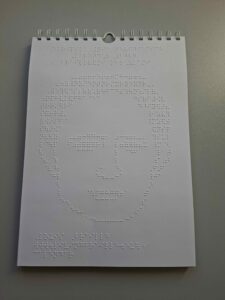
Portrait of Louis Braille, Germany
Author: Christine Lox
Information
Louis Braille, born on 4 January 1809 in Coupvray close to Paris, became blind because of a childhood accident. In 1825 he invented the tactile script for blind people consisting of six dots, now called braille.
Description
A portrait of Louis Braille. He has a rectangular face with a defined, angular chin and a prominent forehead framed by short, curly hair. His eyebrows are fairly straight, and his eyes are closed. His lips are thin and closed.
January
Bicycle, Belgium
Author: CBB
Information
The bicycle is strongly associated with Belgium because of its long cycling tradition. Cycling is particularly important in Flanders, which has produced famous cyclists such as Eddy Merckx, and hosts major races such as the Tour of Flanders. Cycling is also closely connected with the Flemish landscape, where flat countryside, rural roads, canals, and historic cycling routes make it a natural part of everyday life and local culture.
Description
The handlebars are at the top-left corner of the drawing. From there, a double line leads downwards to the horizontal top tube and continues to the fork and the hub, which is surrounded by a circle (the front tyre). Following the top tube to the right, the diagonal down tube leads towards the pedal and upwards is the seat. Where the seat tube meets the top tube, a short double line leads up to the saddle, while a single line extends horizontally to the right to form the rack. Finally, the seat stay runs diagonally down to the rear hub, surrounded by the rear tyre, while the horizontal chain stay connects the pedal to the rear hub.
February
Harp, Ireland
Author: James Bowden
Information
The Irish harp symbolises Ireland’s national identity, heritage, and cultural resilience, standing out as the only national symbol in the world that is a musical instrument. In ancient Gaelic society, professional harpists held an elite status, representing poetry, wisdom, and high culture. The Irish brewery Guinness registered the harp as a trademark in the 1870s. When the Irish Free State adopted the harp as its national emblem in 1922, Guinness already owned the right-facing design. To avoid legal conflict, the official Irish harp was made to face left (with the soundbox on the right).
Description
Start at the bottom of the drawing, at the base of the harp. The diagonal line rising to the right represents the soundbox, which ends at the upper-right curve, called the knee. From there, follow the harp’s contour to the left to find the neck, or harmonic curve. Continue left to the crown, and from there, the vertical double line represents the pillar, back to the base. The single vertical lines in the middle of the harp represent the strings.
March
Freedom Monument, Latvia
Author: Gunta Bite
Information
The Freedom Monument stands in the centre of Riga, Latvia. It was unveiled in 1935 and symbolises Latvia’s freedom, independence and national unity.
At the top of the monument is the figure of Liberty, known as Milda. She holds three stars high above her head. The stars represent the three historical regions of Latvia: Kurzeme, Vidzeme and Latgale.
The three stars are one of the most recognisable symbols of Latvia and its independence.
Description
The tactile image shows the Freedom Monument from the front.
It has a wide, stepped base. The monument becomes narrower as it rises. A tall, straight column forms its central part.
At the top is the figure of Liberty. Her arms are raised. Above her hands are three stars.
The stars form a triangle: one star is at the top and two stars are below it.
The three stars are the highest and most important detail of the image.
April
Windmill, Netherlands
Author: CBB
Information
Traditional Dutch windmills are known for their four large sails and tall, often wooden or stone structures. They played a major role in shaping the country’s landscape and history. Since nearly a third of the Netherlands is below sea level, windmills helped drain wetlands and create fertile farmland. Without these mills, a large part of the country would still be underwater. The flat Dutch landscape made it easy to use the wind to power the mills. They were also used for grinding grain, sawing wood, and other industrial work.
Description
The two horizontal lines at the bottom of the drawing represent the base of the windmill. From each end of the base, a thin vertical line extends upward and ends in a diagonal line. These two lines outline the millhouse. In the centre of the millhouse, there is a rounded triangular shape representing one of the windmill’s sails. The sail ends at the top in a filled square, the hub, from which the three remaining sails extend: one upward, one to the right, and one to the left.
May
International Illustrated Braille Calendar 2027
Brief Information about the Braille Picture for the Month of May
Picture title: Luncheon on the Grass 2027
Author: Jiří Mojžíšek (Jiri Mojzisek)
Country of origin: the Czech Republic
Image Description
- The figure is made up exclusively of dots contained in six-dot Braille cells; it presents no graphics outside the 6-dot Braille system.
- There is a table standing on the grass. You can inspect two long vertical legs on both sides of the picture. The table is covered with a tablecloth; the tablecloth can be easily recognised by its lace hanging over the edge of the table itself.
- There are two tea cups (or rather coffee mugs) placed on the table exhibiting prominent handles on both sides of the picture.
Information
For some, the image may be reminiscent of two famous French paintings from the eighteen sixties. The author of this information is stating unequivocally that the current picture has no resemblance whatsoever with the said French paintings; it relates to the imaginary luncheon on the grass in 2027.
About the Author
Jiří Mojžíšek, 75, is a distinguished Czech blind inventor and computer programmer. His celebrated achievements include the first Czech synthetic voice, a popular Czech notetaker Genie, scores of children’s toys, games and teaching aids. His contribution to the welfare of the blind in this country is universally recognized.
June
Portuguese Guitar, Portugal
Information
The Portuguese guitar is the defining, soul-stirring musical voice of Fado, the traditional urban music genre recognised as UNESCO Intangible Cultural Heritage since 2011. Its unique timbre perfectly captures “saudade”–a distinctively Portuguese concept of profound longing and nostalgia linked to the country’s maritime history. The guitar developed from European string instruments during the 18th and 19th centuries and acquired its characteristic pear- or teardrop-shaped body.
Description
The strings are represented by a series of full braille characters. On the left, they are framed by a circular soundbox and on the right by the guitar neck. To the left of the strings, the soundhole is indicated by a small circle.
July
Wooden Altar of Master Pavol in Levoča, Slovakia
Author: Ingrid Semanová
Information
The historical centre of Levoča is affiliated in a single entry in the UNESCO World Cultural and Natural Heritage List.
St Jacob church in Levoča is one of the most important sacred buildings in Slovakia. It contains 14 Gothic and Renaissance altars, which is the world record.
Description
The late Gothic main altar at a height of 18 m and 62 cm is the tallest of its kind in the world. Made purely of lime wood in 1507-1517 in the workshop of Master Pavol of Levoča the carving, by the Master himself, is of extraordinary high artistic value. It is a triptych: a three-part altar. The retable consists of a cabinet (altar ark) and two movable, closable wings.
August
Klopotec, Slovenia
Author: Marko Bezjak
Listen to the sound of Klopotec
Information
Klopotec is a traditional wooden device characteristic mainly of the wine growing regions of northeastern Slovenia, although it is also known in Austrian Styria and Croatia. In English, Klopotec could be described as a wooden wind rattle.
It is placed in vineyards during the grape ripening season, where its characteristic loud rattling sound is used to scare birds away. It is usually mounted high above the vines, on top of a wooden post and in an open location where it can catch the wind. The wind turns its blades and the wooden axle connected to them. A mechanism on the axle lifts small wooden hammers, which strike a wooden board and create the characteristic rhythmic rattling sound. Traditionally, different types of wood are used for its various parts. Interestingly, Klopotec is not only a device for scaring birds away, but over time it has also become a recognizable symbol of vineyards and wine growing tradition.
Description
On the left side of the image is a large wheel with four blades, driven by the wind. Find the centre of the wheel and move from there to the right. You will reach the mechanism that creates the rhythmic rattling sound. The mechanism consists of four pairs of hammers. Beneath them is a wooden board which they strike, creating the characteristic sound of Klopotec. The entire structure stands on a single wooden post.
At the far right of the image is the tail of the Klopotec. The tail helps the Klopotec turn and align itself with the direction of the wind so that the blades face the wind. Traditionally, the tail is made from fresh birch branches with their leaves still attached.
September
Ferris Wheel (Riesenrad), Austria
Authors: Kristijan Ciganovic, Eva Cambeiro Andrade, Reiner Delgado
Information
The Wiener Riesenrad was built in 1897 in Vienna’s Prater to celebrate the 50th anniversary of Emperor Franz Joseph I’s reign. At around 65 metres high, it was one of the tallest structures of its time and remains the world’s oldest giant Ferris wheel still in operation. It originally had 30 gondolas, but only 15 remain today, after many were destroyed by fire during World War II. The wheel weighs approximately 430 tons and was famously featured in the 1949 film The Third Man.
Description
The bottom of the drawing shows the base of the Riesenrad. Above it, two thick columns rise diagonally and meet in the middle. These are the steel columns that support the entire structure. On top of the supports is the main axle, around which the wheel rotates. Several thin diagonal lines extend from the main axle in different directions, representing the spokes. The double circle surrounding the spokes forms the wheel rim. Along the outer rim, small squares hang at regular intervals, representing the gondolas.
October
Oncelio with Shape of Spain, Spain
Author: Francisco Javier Baeza García
Information
The Oncelio is a symbolic figure for ONCE representing mainly blind members using a white cane.
Description
On the left side of the drawing is the oncelio figure. A filled circle on the top represents the head. Below this is a diagonal thick line from left to right, becoming thin. This represents one arm with the cane. Below the arm is an upside down print V-shape representing the two legs. On the right side there is the shape of Spain with a nearly straight border line in the north and becoming narrower at the south.
November
Elizabeth Tower, United Kingdom
Author: James Bowden
Information
The Elizabeth Tower in London, formerly called the Clock Tower, stands 96 m tall and houses the famous Great Bell known as Big Ben. It was completed in 1859 and renamed in 2012 to honour Queen Elizabeth II’s Diamond Jubilee. The tower has 399 steps to reach the very top and four clock faces, each 7 metres in diameter. Its clock is remarkably accurate, with old Victorian pennies used to fine-tune the pendulum. At the top of the tower, there is a small lantern called the Ayrton Light, which shines when Parliament is in session after dark.
Description
The small roof at the top of the drawing represents the belfry, which contains Big Ben. Below the belfry, there is a large square with a circle in the middle. This is one of the four clock faces. Two hands in the centre of the clock show the time: three o’clock. Below the large square, there is a tall rectangular structure, the tower, with its narrow Gothic-style windows. At about the middle height of the tower, a horizontal double line extends to the right, marking the roof of the adjacent Palace of Westminster. Three vertical lines rising from the roof represent small ornamental towers.
December
Santa and Rudolph, Finland
Author: Anne-laure Janssen
Information
Santa Claus, reindeer and the Northern Lights are three of the images most closely associated with a Finnish winter. Every Finnish child knows that Santa Claus lives on Korvatunturi, a fell in Lapland. Finland is also home to around 200 000 semi-domesticated reindeer, while the Northern Lights can light up the dark northern sky with glowing curtains and waves of colour. Together, they have become an important part of how people in Finland and visitors from around the world imagine the magic of winter in the north.
Description
At the bottom left, there is Santa Claus in his sleigh. He is raising both hands in greeting. In front of the sleigh is Rudolph, his faithful red-nosed reindeer. You can feel his big nose and his long, curving antlers. The top of the image represents the Northern Lights, a veil of light that sometimes appears in the winter sky in northern regions. There is also a star in the middle of the sky.