Reading Braille is not that easy. That’s why many people who touch Braille for the first time say: It’s like woodchip wallpaper.
For both children and blind adults, it can be very useful to train the sense of touch and tactile strategies before and during Braille learning.
Materials and methods that can be used for this:
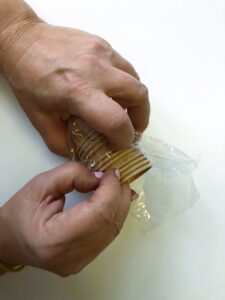
There are many things in our everyday lives that can be felt: With a stack of plates, you can count how many there are by feeling the edges of the plates. The same can be done with plastic cups.
Later, you can increase the difficulty of the exercise by using paper plates and paper cups.
You can also count grooves and bumps on objects, such as the ventilation slots on electrical appliances.
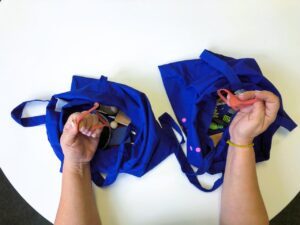
Two types of memory games can help train the sense of touch: To do this, put the same objects in two cloth bags. The participants must now reach into one of the bags with each hand and take out two identical objects from both bags. The game can be made more or less difficult: with a few very different objects or with many very similar ones, e.g., many different screws.
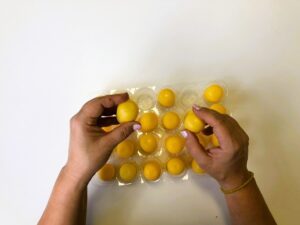
A shaking memory game consists of many identical containers, e.g., capsules from surprise eggs. Two of them are always filled with the same material: sand, rice, screws, paper clips, rubber rings, etc. You take two containers one after the other, shake them, and try to find pairs. When shaken, the different fillings not only sound different, but also feel different.
Euro coins have different tactile features that allow you to distinguish between them. This is not only a good tactile exercise, but also useful for everyday life.
In the video, Odette from Uganda describes how her students train their sense of touch with different natural materials:
Watch the video here
The sense of touch can also be trained with tactile books:
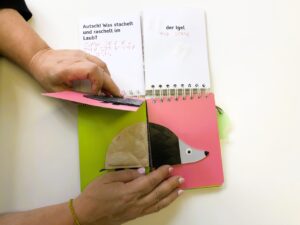
The dzb lesen in Leipzig, Germany, offers “Klapperlapapp books”:
The books feature shapes, lines, pictures of animals, and more. They are divided into two parts. The two halves of the book pages can be turned separately. The aim is to find the right halves for a picture. Or you can create funny animals, e.g., with the head of a giraffe and the tail of a crocodile.
The book Rike Ringelnatter, komm nach Hause (Rike Grass Snake, Come Home) from the DBSV contains tactile exercises that are particularly important for learning to read: counting, recognizing shapes, tracing lines, and comparing lengths.
Find it here
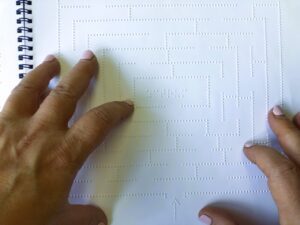
Tactile mazes are very well suited for preparing the sense of touch for Braille. The dzb lesen offers several maze books
here:
The next article will deal with further materials printed on paper for tactile training.
Braille lernen und verstehen: Tastschulung zur Vorbereitung auf das Braille Lernen
Brailleschrift lesen ist gar nicht so leicht. Darum sagen auch viele, die Braille zum Ersten Mal berühren: Das ist doch Raufasertapete.
Sowohl bei Kindern als auch bei erblindeten Erwachsenen kann es sehr sinnvoll sein, vor und während dem Braille Lernen den Tastsinn und Taststrategien zu schulen.
Materialien und Methoden, die man dafür verwenden kann:
In unserem Alltag gibt es viele Dinge, die man ertasten kann: An einem Stapel von Tellern kann man außen an den Rändern der Teller zählen, wie viele es sind. Dasselbe geht auch mit Plastikbechern.
Später kann man den Schwierigkeitsgrad der Übung durch die Verwendung von Papptellern und Pappbechern steigern.
Auch Rillen und Noppen auf Gegenständen kann man zählen, z. B. die Lüftungsschlitze an Elektrogeräten.
Zwei Arten des Memory-Spiels können helfen, den Tastsinn zu schulen: Tue hierfür in zwei Stoffbeutel jeweils die gleichen Gegenstände. Die Teilnehmenden müssen nun mit jeder Hand in einen der Beutel fassen und aus beiden Beuteln zwei gleiche Gegenstände herausholen. Das Spiel kann unterschiedlich schwer gestaltet werden: Mit wenigen sehr verschiedenen Gegenständen oder mit vielen sehr ähnlichen, z. b. viele unterschiedliche Schrauben.
Ein Schüttel-Memory besteht aus vielen gleichen Dosen, z. B. Kapseln von Überraschungseiern. Immer je zwei davon sind mit dem gleichen material gefüllt: Sand, Reis, Schrauben, Büroklammern, Gummiringe etc. Man nimmt zwei Dosen nacheinander, schüttelt sie und versucht Paare zu finden. Beim schütteln klingen die unterschiedlichen Füllungen nämlich nicht nur anders, sondern auch das Gefühl beim Schütteln ist immer unterschiedlich.
Die Euro-Geldmünzen haben unterschiedliche taktile Merkmale, mit denen man sie unterscheiden kann. Das ist nicht nur eine gute Tastübung, sondern auch eine für den Alltag.
Odette aus Uganda beschreibt im Video, wie ihre Schüler mit unterschiedlichen Naturmaterialien ihren Tastsinn trainieren:
Das Video gibt es hier:
Auch mit Tastbaren Büchern kann der Tastsinn trainiert werden: Das dzb lesen in Leipzig/Deutschland bietet die
„Klapperlapapp-Bücher“:
Die Bücher haben Formen, Linien, Bilder von Tieren und mehr. Sie sind zweigeteilt. Die beiden Hälften der Buchseiten können getrennt umgeblättert werden. Man soll die richtigen Hälften für ein Bild zusammensuchen. Oder man bildet lustige Tiere, z.B. mit dem Kopf einer Giraffe und dem Schwanz eines Krokodils.
Das Buch Rike Ringelnatter, komm nach Hause des DBSV enthält Tastübungen, die besonders für das Lesen Lernen wichtig sind: Zählen, Formen Erkennen, Linien Verfolgen oder Längen Vergleichen.
Hier gehts zum Buch
Tastbare Labyrinthe eignen sich sehr gut, um den Tastsinn auf braille vorzubereiten. Das dzb lesen hat einige Labyrinthbücher im Angebot
welches ihr hier findet:
Um weitere auf Papier gedruckte Materialien zur Tasstschulung geht es im nächsten Beitrag.
useful links:
Read all articles on: livingbraille.eu
Contact us with your contributions, ideas and questions by: braille200@livingbraille.eu
Social media: Braille 200 on Facebook